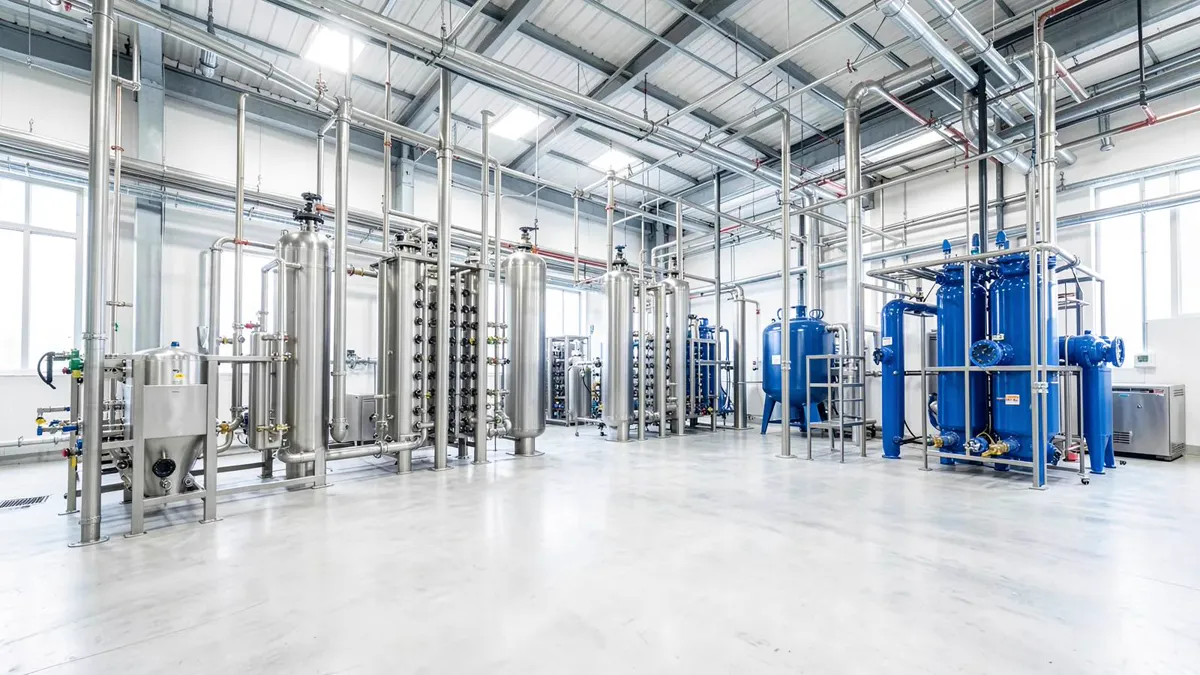
An industrial water system connects the water source to process requirements. Design does not end with membrane selection. It includes pretreatment, pumps and system components where required, membrane array, measurement and control, polishing, drainage, flushing, maintenance and operation.
Definition starts with a water balance: inlet volume, required product flow, concentrate handling and demand variation. Chemistry, temperature, pressures, space constraints and integration with existing infrastructure are then reviewed. A suitable solution must be operable and maintainable, not merely achieve one laboratory value.
Membrane systems
RO, NF and UF are reviewed according to process objective, feed characteristics and product requirements.
Pretreatment and polishing
A treatment train may combine filtration, softening, ion exchange, dosing, disinfection or EDI according to the application.
Project configuration
Skid-mounted, modular or containerized only within Nimbus's approved actual supply scope.
Industrial Water Treatment Systems and Equipment
Beyond membranes, Nimbus engineers and supplies complete systems and components as an independent solution provider working with multiple suppliers.
Industrial RO Systems and Skids
Complete skid-mounted RO systems with pretreatment, pumps, pressure vessels, piping and controls, according to the design.
Information is general and is not a quotation or fit approval. Selection follows a data review.
Water Source and Feed Conditions
Different water sources require different design approaches. Municipal water, brackish water, groundwater, process water, rinse streams and reuse streams may exhibit substantially different quality profiles and variability characteristics.
System planning evaluates source water data together with application requirements to establish the appropriate treatment train and target quality objectives.
Water Systems For Production Processes
In many industrial facilities water functions as an operational raw material. Water quality may directly influence process efficiency, equipment reliability and production stability.
Typical applications include process water, rinse water, boiler feed systems, cooling systems and numerous operational processes.
System-Oriented Water Treatment Strategy
Modern water systems are frequently constructed as integrated treatment trains where each process stage influences downstream performance. Professional planning therefore evaluates the complete treatment sequence rather than individual components in isolation.
How does changing water quality affect treatment systems?
Variations in feed water characteristics may influence treatment performance, operating strategy and maintenance considerations.
What is a water balance in an industrial project?
A water balance evaluates incoming, outgoing and reusable water streams to support treatment planning.
Why are operating hours important?
Operating schedules influence sizing, operational strategy and performance expectations.
Can water quality requirements differ within the same facility?
Yes. Different applications within the same site may require different water quality levels.
What maintenance considerations are typically reviewed?
Accessibility, monitoring capability, maintenance procedures and service requirements are commonly reviewed.
What is recovery in a reverse osmosis system?
Recovery describes the relationship between product-water flow and feed-water flow under defined operating conditions.
Why is water temperature reviewed during system planning?
Water temperature may influence process characteristics and operating conditions and is therefore reviewed during planning.
Does target water quality influence technology selection?
Yes. Target water quality is one of the primary factors influencing treatment selection.
Why is pretreatment commonly included?
Pretreatment helps prepare feed water for downstream processes according to project requirements and water characteristics.
Are all RO systems designed the same way?
No. System architecture varies according to project objectives, water quality and operating requirements.
Selecting a water-treatment solution is an engineering and operational process. It begins with the water source, composition, variation over time, required flow, target quality, operating hours, site constraints and maintenance approach. A technology name alone is not sufficient to establish suitability.
Website information is general and is not a quotation, binding specification, fit approval or engineering approval. Scope, equipment, performance and conditions will be determined only after data review and an approved Nimbus proposal.