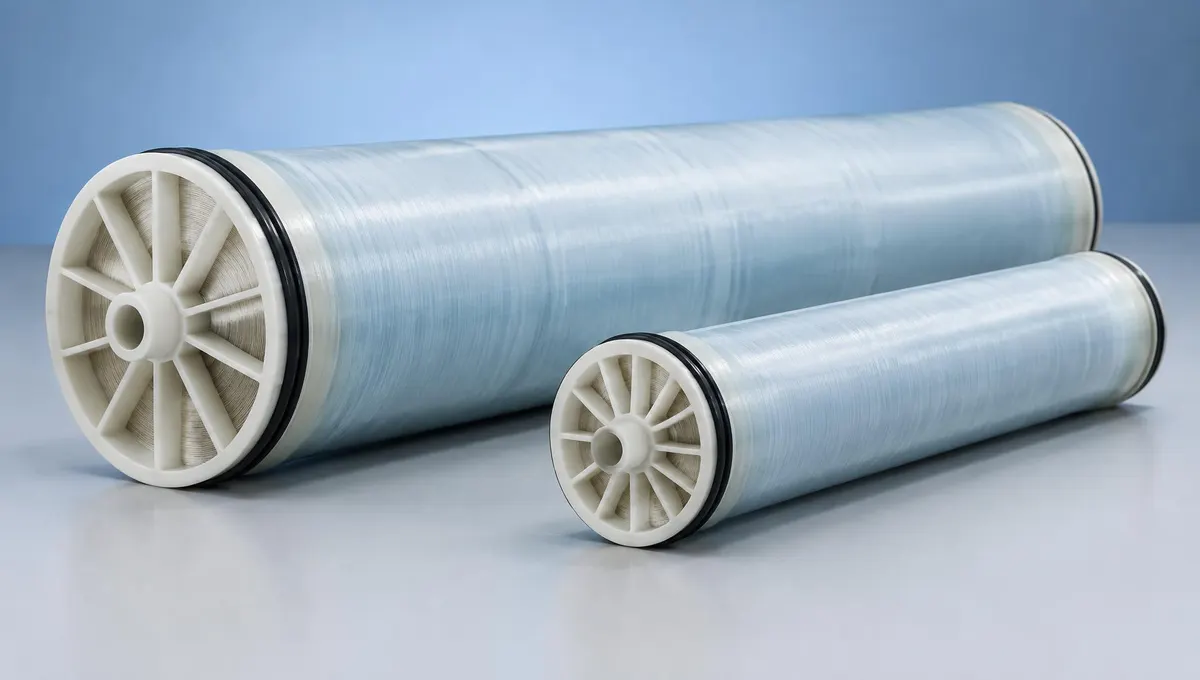
| NIM-XLE-8040-HF | Extreme Low Pressure | 8040 | 28mil | 13,000 GPD49.2 m³/d | 99% | 100psi, 500ppm Nacl,15% recovery rate, 25℃,PH 7.5-8.0 |
|---|
+Full Specs — NIM-XLE-8040-HFActive Membrane Area- Active Membrane Area
- 440 ft² (40.9 m²)
Operating Limits- Max Operating Pressure
- 600 psi (41 bar)
- Max Operating Temperature
- 45°C (113°F)
- Continuous Operating pH
- 2.0–11.0
- CIP pH Range
- 1.0–12.0
- Maximum Feed Water Silt Density Index
- SDI15 < 5.0
- Free Chlorine Tolerance
- < 0.1 ppm
- Max Pressure Drop per Element
- 15 psi (1.0 bar)
Dimensions- Length
- 40.0 in (1,016 mm)
- Outer Diameter
- 7.9 in (201 mm)
- Central Tube Diameter
- 1.125 in (28.6 mm)
Standard Test Conditions- Test Pressure
- 100 psi
- Salt Concentration
- 500 ppm NaCl
- Test Temperature
- 25°C
- Recovery
- 15%
- Test pH
- 7.5-8.0
|
| NIM-XLE-8040 | Extreme Low Pressure | 8040 | 28mil | 11,000 GPD41.6 m³/d | 99.2% | 100psi, 500ppm Nacl,15% recovery rate, 25℃,PH 7.5-8.0 |
|---|
+Full Specs — NIM-XLE-8040Active Membrane Area- Active Membrane Area
- 400 ft² (37.2 m²)
Operating Limits- Max Operating Pressure
- 600 psi (41 bar)
- Max Operating Temperature
- 45°C (113°F)
- Continuous Operating pH
- 2.0–11.0
- CIP pH Range
- 1.0–12.0
- Maximum Feed Water Silt Density Index
- SDI15 < 5.0
- Free Chlorine Tolerance
- < 0.1 ppm
- Max Pressure Drop per Element
- 15 psi (1.0 bar)
Dimensions- Length
- 40.0 in (1,016 mm)
- Outer Diameter
- 7.9 in (201 mm)
- Central Tube Diameter
- 1.125 in (28.6 mm)
Standard Test Conditions- Test Pressure
- 100 psi
- Salt Concentration
- 500 ppm NaCl
- Test Temperature
- 25°C
- Recovery
- 15%
- Test pH
- 7.5-8.0
|
| NIM-XLE-4040-HF | Extreme Low Pressure | 4040 | 28mil | 3,500 GPD13.2 m³/d | 99% | 100psi, 500ppm Nacl,15% recovery rate, 25℃,PH 7.5-8.0 |
|---|
+Full Specs — NIM-XLE-4040-HFActive Membrane Area- Active Membrane Area
- 85–90 ft² (7.9–8.4 m²)
Operating Limits- Max Operating Pressure
- 600 psi (41 bar)
- Max Operating Temperature
- 45°C (113°F)
- Continuous Operating pH
- 2.0–11.0
- CIP pH Range
- 1.0–12.0
- Maximum Feed Water Silt Density Index
- SDI15 < 5.0
- Free Chlorine Tolerance
- < 0.1 ppm
- Max Pressure Drop per Element
- 15 psi (1.0 bar)
Dimensions- Length
- 40.0 in (1,016 mm)
- Outer Diameter
- 3.9 in (99 mm)
- Central Tube Diameter
- 0.75 in (19.0 mm)
Standard Test Conditions- Test Pressure
- 100 psi
- Salt Concentration
- 500 ppm NaCl
- Test Temperature
- 25°C
- Recovery
- 15%
- Test pH
- 7.5-8.0
|
| NIM-XLE-4040 | Extreme Low Pressure | 4040 | 28mil | 2,600 GPD9.8 m³/d | 99.2% | 100psi, 500ppm Nacl,15% recovery rate, 25℃,PH 7.5-8.0 |
|---|
+Full Specs — NIM-XLE-4040Active Membrane Area- Active Membrane Area
- 85–90 ft² (7.9–8.4 m²)
Operating Limits- Max Operating Pressure
- 600 psi (41 bar)
- Max Operating Temperature
- 45°C (113°F)
- Continuous Operating pH
- 2.0–11.0
- CIP pH Range
- 1.0–12.0
- Maximum Feed Water Silt Density Index
- SDI15 < 5.0
- Free Chlorine Tolerance
- < 0.1 ppm
- Max Pressure Drop per Element
- 15 psi (1.0 bar)
Dimensions- Length
- 40.0 in (1,016 mm)
- Outer Diameter
- 3.9 in (99 mm)
- Central Tube Diameter
- 0.75 in (19.0 mm)
Standard Test Conditions- Test Pressure
- 100 psi
- Salt Concentration
- 500 ppm NaCl
- Test Temperature
- 25°C
- Recovery
- 15%
- Test pH
- 7.5-8.0
|
| NIM-BW-LE-8040-HF | Low Pressure | 8040 | 28mil | 12,500 GPD47.3 m³/d | 99.5% | 150psi,1500ppm Nacl,15% recovery rate, 25℃,PH 7.5-8.0 |
|---|
+Full Specs — NIM-BW-LE-8040-HFActive Membrane Area- Active Membrane Area
- 440 ft² (40.9 m²)
Operating Limits- Max Operating Pressure
- 600 psi (41 bar)
- Max Operating Temperature
- 45°C (113°F)
- Continuous Operating pH
- 2.0–11.0
- CIP pH Range
- 1.0–12.0
- Maximum Feed Water Silt Density Index
- SDI15 < 5.0
- Free Chlorine Tolerance
- < 0.1 ppm
- Max Pressure Drop per Element
- 15 psi (1.0 bar)
Dimensions- Length
- 40.0 in (1,016 mm)
- Outer Diameter
- 7.9 in (201 mm)
- Central Tube Diameter
- 1.125 in (28.6 mm)
Standard Test Conditions- Test Pressure
- 150 psi
- Salt Concentration
- 1500 ppm NaCl
- Test Temperature
- 25°C
- Recovery
- 15%
- Test pH
- 7.5-8.0
|
| NIM-BW-LE-8040-MR | Low Pressure | 8040 | 28mil | 10,500 GPD39.7 m³/d | 99.6% | 150psi,1500ppm Nacl,15% recovery rate, 25℃,PH 7.5-8.0 |
|---|
+Full Specs — NIM-BW-LE-8040-MRActive Membrane Area- Active Membrane Area
- 400 ft² (37.2 m²)
Operating Limits- Max Operating Pressure
- 600 psi (41 bar)
- Max Operating Temperature
- 45°C (113°F)
- Continuous Operating pH
- 2.0–11.0
- CIP pH Range
- 1.0–12.0
- Maximum Feed Water Silt Density Index
- SDI15 < 5.0
- Free Chlorine Tolerance
- < 0.1 ppm
- Max Pressure Drop per Element
- 15 psi (1.0 bar)
Dimensions- Length
- 40.0 in (1,016 mm)
- Outer Diameter
- 7.9 in (201 mm)
- Central Tube Diameter
- 1.125 in (28.6 mm)
Standard Test Conditions- Test Pressure
- 150 psi
- Salt Concentration
- 1500 ppm NaCl
- Test Temperature
- 25°C
- Recovery
- 15%
- Test pH
- 7.5-8.0
|
| NIM-BW-LE-4040-HF | Low Pressure | 4040 | 28mil | 2,700 GPD10.2 m³/d | 99.5% | 150psi,1500ppm Nacl,15% recovery rate, 25℃,PH 7.5-8.0 |
|---|
+Full Specs — NIM-BW-LE-4040-HFActive Membrane Area- Active Membrane Area
- 85–90 ft² (7.9–8.4 m²)
Operating Limits- Max Operating Pressure
- 600 psi (41 bar)
- Max Operating Temperature
- 45°C (113°F)
- Continuous Operating pH
- 2.0–11.0
- CIP pH Range
- 1.0–12.0
- Maximum Feed Water Silt Density Index
- SDI15 < 5.0
- Free Chlorine Tolerance
- < 0.1 ppm
- Max Pressure Drop per Element
- 15 psi (1.0 bar)
Dimensions- Length
- 40.0 in (1,016 mm)
- Outer Diameter
- 3.9 in (99 mm)
- Central Tube Diameter
- 0.75 in (19.0 mm)
Standard Test Conditions- Test Pressure
- 150 psi
- Salt Concentration
- 1500 ppm NaCl
- Test Temperature
- 25°C
- Recovery
- 15%
- Test pH
- 7.5-8.0
|
| NIM-BW-LE-4040-MR | Low Pressure | 4040 | 28mil | 2,400 GPD9.1 m³/d | 99.6% | 150psi,1500ppm Nacl,15% recovery rate, 25℃,PH 7.5-8.0 |
|---|
+Full Specs — NIM-BW-LE-4040-MRActive Membrane Area- Active Membrane Area
- 85–90 ft² (7.9–8.4 m²)
Operating Limits- Max Operating Pressure
- 600 psi (41 bar)
- Max Operating Temperature
- 45°C (113°F)
- Continuous Operating pH
- 2.0–11.0
- CIP pH Range
- 1.0–12.0
- Maximum Feed Water Silt Density Index
- SDI15 < 5.0
- Free Chlorine Tolerance
- < 0.1 ppm
- Max Pressure Drop per Element
- 15 psi (1.0 bar)
Dimensions- Length
- 40.0 in (1,016 mm)
- Outer Diameter
- 3.9 in (99 mm)
- Central Tube Diameter
- 0.75 in (19.0 mm)
Standard Test Conditions- Test Pressure
- 150 psi
- Salt Concentration
- 1500 ppm NaCl
- Test Temperature
- 25°C
- Recovery
- 15%
- Test pH
- 7.5-8.0
|
| NIM-BW-8040-HF | Brackish Water | 8040 | 28mil | 13,000 GPD49.2 m³/d | 99.55% | 225psi,2000ppm Nacl,15% recovery rate, 25℃,PH 7.5-8.0 |
|---|
+Full Specs — NIM-BW-8040-HFActive Membrane Area- Active Membrane Area
- 440 ft² (40.9 m²)
Operating Limits- Max Operating Pressure
- 600 psi (41 bar)
- Max Operating Temperature
- 45°C (113°F)
- Continuous Operating pH
- 2.0–11.0
- CIP pH Range
- 1.0–12.0
- Maximum Feed Water Silt Density Index
- SDI15 < 5.0
- Free Chlorine Tolerance
- < 0.1 ppm
- Max Pressure Drop per Element
- 15 psi (1.0 bar)
Dimensions- Length
- 40.0 in (1,016 mm)
- Outer Diameter
- 7.9 in (201 mm)
- Central Tube Diameter
- 1.125 in (28.6 mm)
Standard Test Conditions- Test Pressure
- 225 psi
- Salt Concentration
- 2000 ppm NaCl
- Test Temperature
- 25°C
- Recovery
- 15%
- Test pH
- 7.5-8.0
|
| NIM-BW-8040 | Brackish Water | 8040 | 28mil | 10,500 GPD39.7 m³/d | 99.7% | 225psi,2000ppm Nacl,15% recovery rate, 25℃,PH 7.5-8.0 |
|---|
+Full Specs — NIM-BW-8040Active Membrane Area- Active Membrane Area
- 400 ft² (37.2 m²)
Operating Limits- Max Operating Pressure
- 600 psi (41 bar)
- Max Operating Temperature
- 45°C (113°F)
- Continuous Operating pH
- 2.0–11.0
- CIP pH Range
- 1.0–12.0
- Maximum Feed Water Silt Density Index
- SDI15 < 5.0
- Free Chlorine Tolerance
- < 0.1 ppm
- Max Pressure Drop per Element
- 15 psi (1.0 bar)
Dimensions- Length
- 40.0 in (1,016 mm)
- Outer Diameter
- 7.9 in (201 mm)
- Central Tube Diameter
- 1.125 in (28.6 mm)
Standard Test Conditions- Test Pressure
- 225 psi
- Salt Concentration
- 2000 ppm NaCl
- Test Temperature
- 25°C
- Recovery
- 15%
- Test pH
- 7.5-8.0
|
| NIM-BW-8040-E | Brackish Water | 8040 | 28mil | 10,500 GPD39.7 m³/d | 99.55% | 225psi,2000ppm Nacl,15% recovery rate, 25℃,PH 7.5-8.0 |
|---|
+Full Specs — NIM-BW-8040-EActive Membrane Area- Active Membrane Area
- 400 ft² (37.2 m²)
Operating Limits- Max Operating Pressure
- 600 psi (41 bar)
- Max Operating Temperature
- 45°C (113°F)
- Continuous Operating pH
- 2.0–11.0
- CIP pH Range
- 1.0–12.0
- Maximum Feed Water Silt Density Index
- SDI15 < 5.0
- Free Chlorine Tolerance
- < 0.1 ppm
- Max Pressure Drop per Element
- 15 psi (1.0 bar)
Dimensions- Length
- 40.0 in (1,016 mm)
- Outer Diameter
- 7.9 in (201 mm)
- Central Tube Diameter
- 1.125 in (28.6 mm)
Standard Test Conditions- Test Pressure
- 225 psi
- Salt Concentration
- 2000 ppm NaCl
- Test Temperature
- 25°C
- Recovery
- 15%
- Test pH
- 7.5-8.0
|
| NIM-BW-4040-HF | Brackish Water | 4040 | 28mil | 2,900 GPD11 m³/d | 99.5% | 225psi,2000ppm Nacl,15% recovery rate, 25℃,PH 7.5-8.0 |
|---|
+Full Specs — NIM-BW-4040-HFActive Membrane Area- Active Membrane Area
- 85–90 ft² (7.9–8.4 m²)
Operating Limits- Max Operating Pressure
- 600 psi (41 bar)
- Max Operating Temperature
- 45°C (113°F)
- Continuous Operating pH
- 2.0–11.0
- CIP pH Range
- 1.0–12.0
- Maximum Feed Water Silt Density Index
- SDI15 < 5.0
- Free Chlorine Tolerance
- < 0.1 ppm
- Max Pressure Drop per Element
- 15 psi (1.0 bar)
Dimensions- Length
- 40.0 in (1,016 mm)
- Outer Diameter
- 3.9 in (99 mm)
- Central Tube Diameter
- 0.75 in (19.0 mm)
Standard Test Conditions- Test Pressure
- 225 psi
- Salt Concentration
- 2000 ppm NaCl
- Test Temperature
- 25°C
- Recovery
- 15%
- Test pH
- 7.5-8.0
|
| NIM-BW-4040 | Brackish Water | 4040 | 28mil | 2,500 GPD9.5 m³/d | 99.6% | 225psi,2000ppm Nacl,15% recovery rate, 25℃,PH 7.5-8.0 |
|---|
+Full Specs — NIM-BW-4040Active Membrane Area- Active Membrane Area
- 85–90 ft² (7.9–8.4 m²)
Operating Limits- Max Operating Pressure
- 600 psi (41 bar)
- Max Operating Temperature
- 45°C (113°F)
- Continuous Operating pH
- 2.0–11.0
- CIP pH Range
- 1.0–12.0
- Maximum Feed Water Silt Density Index
- SDI15 < 5.0
- Free Chlorine Tolerance
- < 0.1 ppm
- Max Pressure Drop per Element
- 15 psi (1.0 bar)
Dimensions- Length
- 40.0 in (1,016 mm)
- Outer Diameter
- 3.9 in (99 mm)
- Central Tube Diameter
- 0.75 in (19.0 mm)
Standard Test Conditions- Test Pressure
- 225 psi
- Salt Concentration
- 2000 ppm NaCl
- Test Temperature
- 25°C
- Recovery
- 15%
- Test pH
- 7.5-8.0
|
| NIM-BW-4040-E | Brackish Water | 4040 | 28mil | 2,400 GPD9.1 m³/d | 99.5% | 225psi,2000ppm Nacl,15% recovery rate, 25℃,PH 7.5-8.0 |
|---|
+Full Specs — NIM-BW-4040-EActive Membrane Area- Active Membrane Area
- 85–90 ft² (7.9–8.4 m²)
Operating Limits- Max Operating Pressure
- 600 psi (41 bar)
- Max Operating Temperature
- 45°C (113°F)
- Continuous Operating pH
- 2.0–11.0
- CIP pH Range
- 1.0–12.0
- Maximum Feed Water Silt Density Index
- SDI15 < 5.0
- Free Chlorine Tolerance
- < 0.1 ppm
- Max Pressure Drop per Element
- 15 psi (1.0 bar)
Dimensions- Length
- 40.0 in (1,016 mm)
- Outer Diameter
- 3.9 in (99 mm)
- Central Tube Diameter
- 0.75 in (19.0 mm)
Standard Test Conditions- Test Pressure
- 225 psi
- Salt Concentration
- 2000 ppm NaCl
- Test Temperature
- 25°C
- Recovery
- 15%
- Test pH
- 7.5-8.0
|
| NIM-BW-8040XLFR | Fouling Resistant | 8040 | 34mil | 11,500 GPD43.5 m³/d | 99.75% | 225psi,2000ppm Nacl,15% recovery rate, 25℃,PH 7.5-8.0 |
|---|
+Full Specs — NIM-BW-8040XLFRActive Membrane Area- Active Membrane Area
- 400 ft² (37.2 m²)
Operating Limits- Max Operating Pressure
- 600 psi (41 bar)
- Max Operating Temperature
- 45°C (113°F)
- Continuous Operating pH
- 2.0–11.0
- CIP pH Range
- 1.0–12.0
- Maximum Feed Water Silt Density Index
- SDI15 < 5.0
- Free Chlorine Tolerance
- < 0.1 ppm
- Max Pressure Drop per Element
- 15 psi (1.0 bar)
Dimensions- Length
- 40.0 in (1,016 mm)
- Outer Diameter
- 7.9 in (201 mm)
- Central Tube Diameter
- 1.125 in (28.6 mm)
Standard Test Conditions- Test Pressure
- 225 psi
- Salt Concentration
- 2000 ppm NaCl
- Test Temperature
- 25°C
- Recovery
- 15%
- Test pH
- 7.5-8.0
|
| NIM-BW-FR-8040-LD | Fouling Resistant | 8040 | 34mil-LD | 10,500 GPD39.7 m³/d | 99.75% | 225psi,2000ppm Nacl,15% recovery rate, 25℃,PH 7.5-8.0 |
|---|
+Full Specs — NIM-BW-FR-8040-LDActive Membrane Area- Active Membrane Area
- 400 ft² (37.2 m²)
Operating Limits- Max Operating Pressure
- 600 psi (41 bar)
- Max Operating Temperature
- 45°C (113°F)
- Continuous Operating pH
- 2.0–11.0
- CIP pH Range
- 1.0–12.0
- Maximum Feed Water Silt Density Index
- SDI15 < 5.0
- Free Chlorine Tolerance
- < 0.1 ppm
- Max Pressure Drop per Element
- 15 psi (1.0 bar)
Dimensions- Length
- 40.0 in (1,016 mm)
- Outer Diameter
- 7.9 in (201 mm)
- Central Tube Diameter
- 1.125 in (28.6 mm)
Standard Test Conditions- Test Pressure
- 225 psi
- Salt Concentration
- 2000 ppm NaCl
- Test Temperature
- 25°C
- Recovery
- 15%
- Test pH
- 7.5-8.0
|
| NIM-BW-FR-4040 | Fouling Resistant | 4040 | 34mil | 2,300 GPD8.7 m³/d | 99.6% | 225psi,2000ppm Nacl,15% recovery rate, 25℃,PH 7.5-8.0 |
|---|
+Full Specs — NIM-BW-FR-4040Active Membrane Area- Active Membrane Area
- 85–90 ft² (7.9–8.4 m²)
Operating Limits- Max Operating Pressure
- 600 psi (41 bar)
- Max Operating Temperature
- 45°C (113°F)
- Continuous Operating pH
- 2.0–11.0
- CIP pH Range
- 1.0–12.0
- Maximum Feed Water Silt Density Index
- SDI15 < 5.0
- Free Chlorine Tolerance
- < 0.1 ppm
- Max Pressure Drop per Element
- 15 psi (1.0 bar)
Dimensions- Length
- 40.0 in (1,016 mm)
- Outer Diameter
- 3.9 in (99 mm)
- Central Tube Diameter
- 0.75 in (19.0 mm)
Standard Test Conditions- Test Pressure
- 225 psi
- Salt Concentration
- 2000 ppm NaCl
- Test Temperature
- 25°C
- Recovery
- 15%
- Test pH
- 7.5-8.0
|
| NIM-SW-8040-HF | Sea Water | 8040 | 28mil | 9,000 GPD34.1 m³/d | 99.85% | 800psi,32000ppm Nacl,8% recovery rate, 25℃,PH 7.5-8.0 |
|---|
+Full Specs — NIM-SW-8040-HFActive Membrane Area- Active Membrane Area
- 440 ft² (40.9 m²)
Operating Limits- Max Operating Pressure
- 1,200 psi (83 bar)
- Max Operating Temperature
- 45°C (113°F)
- Continuous Operating pH
- 2.0–11.0
- CIP pH Range
- 1.0–12.0
- Maximum Feed Water Silt Density Index
- SDI15 < 5.0
- Free Chlorine Tolerance
- < 0.1 ppm
- Max Pressure Drop per Element
- 15 psi (1.0 bar)
Dimensions- Length
- 40.0 in (1,016 mm)
- Outer Diameter
- 7.9 in (201 mm)
- Central Tube Diameter
- 1.125 in (28.6 mm)
Standard Test Conditions- Test Pressure
- 800 psi
- Salt Concentration
- 32000 ppm NaCl
- Test Temperature
- 25°C
- Recovery
- 8%
- Test pH
- 7.5-8.0
|
| NIM-SW-8040-FR | Sea Water | 8040 | 34mil-LD | 9,000 GPD34.1 m³/d | 99.85% | 800psi,32000ppm Nacl,8% recovery rate, 25℃,PH 7.5-8.0 |
|---|
+Full Specs — NIM-SW-8040-FRActive Membrane Area- Active Membrane Area
- 380–400 ft²
Operating Limits- Max Operating Pressure
- 1,200 psi (83 bar)
- Max Operating Temperature
- 45°C (113°F)
- Continuous Operating pH
- 2.0–11.0
- CIP pH Range
- 1.0–12.0
- Maximum Feed Water Silt Density Index
- SDI15 < 5.0
- Free Chlorine Tolerance
- < 0.1 ppm
- Max Pressure Drop per Element
- 15 psi (1.0 bar)
Dimensions- Length
- 40.0 in (1,016 mm)
- Outer Diameter
- 7.9 in (201 mm)
- Central Tube Diameter
- 1.125 in (28.6 mm)
Standard Test Conditions- Test Pressure
- 800 psi
- Salt Concentration
- 32000 ppm NaCl
- Test Temperature
- 25°C
- Recovery
- 8%
- Test pH
- 7.5-8.0
|
| NIM-SW-8040-SHF | Sea Water | 8040 | 28mil | 10,000 GPD37.9 m³/d | 99.75% | 800psi,32000ppm Nacl,8% recovery rate, 25℃,PH 7.5-8.0 |
|---|
+Full Specs — NIM-SW-8040-SHFActive Membrane Area- Active Membrane Area
- 440 ft² (40.9 m²)
Operating Limits- Max Operating Pressure
- 1,200 psi (83 bar)
- Max Operating Temperature
- 45°C (113°F)
- Continuous Operating pH
- 2.0–11.0
- CIP pH Range
- 1.0–12.0
- Maximum Feed Water Silt Density Index
- SDI15 < 5.0
- Free Chlorine Tolerance
- < 0.1 ppm
- Max Pressure Drop per Element
- 15 psi (1.0 bar)
Dimensions- Length
- 40.0 in (1,016 mm)
- Outer Diameter
- 7.9 in (201 mm)
- Central Tube Diameter
- 1.125 in (28.6 mm)
Standard Test Conditions- Test Pressure
- 800 psi
- Salt Concentration
- 32000 ppm NaCl
- Test Temperature
- 25°C
- Recovery
- 8%
- Test pH
- 7.5-8.0
|
| NIM-SW-4040-HF | Sea Water | 4040 | 28mil | 2,000 GPD7.6 m³/d | 99.8% | 800psi,32000ppm Nacl,8% recovery rate, 25℃,PH 7.5-8.0 |
|---|
+Full Specs — NIM-SW-4040-HFActive Membrane Area- Active Membrane Area
- 85–90 ft² (7.9–8.4 m²)
Operating Limits- Max Operating Pressure
- 1,200 psi (83 bar)
- Max Operating Temperature
- 45°C (113°F)
- Continuous Operating pH
- 2.0–11.0
- CIP pH Range
- 1.0–12.0
- Maximum Feed Water Silt Density Index
- SDI15 < 5.0
- Free Chlorine Tolerance
- < 0.1 ppm
- Max Pressure Drop per Element
- 15 psi (1.0 bar)
Dimensions- Length
- 40.0 in (1,016 mm)
- Outer Diameter
- 3.9 in (99 mm)
- Central Tube Diameter
- 0.75 in (19.0 mm)
Standard Test Conditions- Test Pressure
- 800 psi
- Salt Concentration
- 32000 ppm NaCl
- Test Temperature
- 25°C
- Recovery
- 8%
- Test pH
- 7.5-8.0
|
| NIM-NF1-8040 | Nanofiltration (NF) — High Rejection | 8040 | — | — | — | — |
|---|
| NIM-NF1-8040R | Nanofiltration (NF) — High Rejection | 8040 | — | — | — | — |
|---|
| NIM-NF1-4040 | Nanofiltration (NF) — High Rejection | 4040 | — | — | — | — |
|---|
| NIM-NF1-4040R | Nanofiltration (NF) — High Rejection | 4040 | — | — | — | — |
|---|
| NIM-NF1-2540 | Nanofiltration (NF) — High Rejection | 2540 | — | — | — | — |
|---|
| NIM-NF2-8040 | Nanofiltration (NF) — High Permeability | 8040 | — | — | — | — |
|---|
| NIM-NF2-4040 | Nanofiltration (NF) — High Permeability | 4040 | — | — | — | — |
|---|
| NIM-NF2-2540 | Nanofiltration (NF) — High Permeability | 2540 | — | — | — | — |
|---|
| NIM-MS-8040M | Nanofiltration (NF) — Material Separation | 8040 | — | — | — | — |
|---|
| NIM-MS-8040H | Nanofiltration (NF) — Material Separation | 8040 | — | — | — | — |
|---|